Participate
Join the Embrun Historical Society as a member or volunteer and help keep our local stories alive.
Become a Member
Becoming a member of the Embrun Historical Society means joining a community that values local history and preservation. Your small $10 annual fee helps support exhibits, events, and ongoing efforts to share Embrun’s story with future generations.

Become a Volunteer
Volunteering with the Embrun Historical Society can include helping at fairs, fundraising, and sharing Embrun’s history with the community. Volunteers play a vital role in raising awareness and supporting local events.

His Story in His Own Words
Jean-Pierre Proulx
Career at Parks Canada
I was born in 1943 in Plessisville (Qc), where I completed my primary and secondary education. I earned my bachelor’s degree from the University of Ottawa in 1966 and my master’s in history in 1968. That same year, I began working as a research historian at Parks Canada, where I remained until my retirement in 1995.
Over those 27 years, I created several exhibitions in historic sites across the Maritime provinces, including Signal Hill, Castle Hill, and Cabot Tower in Newfoundland, Grand-Pré in Nova Scotia, and Red Bay in Labrador. During this same period, I also wrote several works, including a history of Basque whaling in Labrador in the 16th century. This synthesis, several hundred pages long and based on Spanish manuscripts, is now internationally recognized as one of the best studies on the subject.
History of Embrun
My interest in Embrun’s history began in the late 1970s. The Centre franco-ontarien de ressources pédagogiques had asked my wife, teacher Francine Bourgie, to write a document on Embrun’s history for a school program. Since the subject interested me, I decided to help her with the project.
Around the same time, local residents had formed a committee to organize celebrations for Embrun’s 125th anniversary in 1981. I proposed writing a history of Embrun, and the committee — of which I was a member — accepted. That is how the book Histoire d’Embrun, published in 1981, came to be. Notably, this publication won the Clio Award in 1982, given by the Canadian Historical Association for the best regional history book in Canada.
Afterward, I wrote several articles on various topics related to local history, including the history of the fire service (1984), the Caisse populaire (1985), the Sisters of Charity of Ottawa in Embrun (1987), the local church (1991), Embrun au jour le jour (2006), a 100-question quiz on Embrun’s history (2006), the history of the high school (2010), all historical texts inscribed on the Monument de la Francophonie (2018), and two articles published in Le Chaînon (2023 and 2025).
In addition to these publications, I compiled hundreds of pages of information from various sources (parish and municipal archives, newspapers, directories, censuses, etc.) and collected nearly 700 captioned photos related to local history. All this material is now available to the public and organizations at the Embrun library.
Beyond research and publications, I also managed or helped with the creation of Embrun’s coat of arms (1981), the twinning of Embrun, France and Embrun, Canada (1981), a local history museum (1981), the acquisition of the Maison des arts (1981) and the Borne de la liberté (1995), and the public launch of the 100-question history quiz (2006).
Maison des Arts
Originally, this house was located on Hall Road near Carlsbad Spring in the former municipality of Gloucester. Built in the early 1880s by Ewan Cameron, it remained in the family until the late 1970s. In 1980, the National Capital Commission purchased it and designated it as a heritage property due to its unique and relatively rare architectural style — only four similar houses existed in Canada at the time.
However, lacking the financial resources to maintain it, the NCC sold the house to the Township of Russell for the symbolic price of $1. In February 1981, thanks to grants covering most of the costs, Russell moved the house to its current location. Additional federal funding and NCC technical expertise were used to restore the building in time for Embrun’s 125th anniversary celebrations. In short, the acquisition, move, and restoration cost virtually nothing to Russell taxpayers.
Since 1981, the Maison des arts has served as a local history museum for several years, an archive depot, headquarters for l’Hélicon (the predecessor to Maison des arts), a meeting space for various organizations including the Scouts, an exhibition gallery for local artists, a reception venue for official ceremonies such as the unveiling of the Borne de la liberté in 1995, and ultimately the headquarters of the Maison des arts since 1989. In March 2003, the municipality added a 4,000 m² extension to the original building.
New York Central Train Station
I was only minimally involved in the acquisition and management of the former New York Central station. Albert G. C. Bourdeau handled nearly all the arrangements.
Here are some mentions of the station found in my notes:
On April 27, 1897, during a referendum, residents of the Township of Russell voted in favour of By-law #114B-1897, which proposed granting $10,000 to the New York Central Railway as it built a new line between Ottawa and Cornwall. In exchange, the company agreed to adjust its route to serve Russell and Embrun, build stations there, and maintain at least two daily passenger trains. The vote count on April 24, 1897, was 380 in favour and 105 opposed.
On January 4, 1898, the Ottawa Citizen reported that the New York Central station in Russell was nearly completed and praised contractor William Warwick of Brockville for the quality of his work. It is reasonable to believe he also built the Embrun and Berwick stations, given that the Record of Chesterville (February 10) stated that Mr. Warwick was the contractor responsible for the stations along the Ottawa and New York Railway.
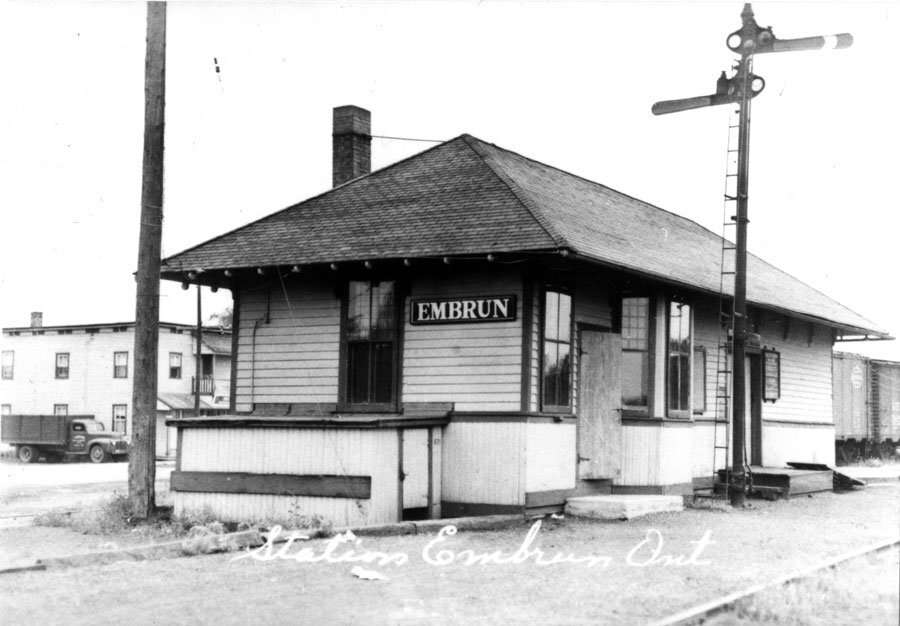
On February 13, 1980, Le Carillon reported that the Township of Russell had purchased the former Berwick station, which would later be moved to Embrun and transformed into a railway museum.
On January 19, 1981, the NCC awarded $10,000 to Russell for restoring the former Berwick New York Central railway station, which had just been relocated to the start of the bike path. This grant funded Mr. Murphy’s restoration work; he had been hired by Albert Bourdeau.
On May 12, 1961, the Township of Russell posted for sale in Le Droit a municipal hall measuring 36 by 72 feet. The two-storey building in Embrun was in perfect condition. It is difficult to determine exactly which building this refers to — it may have been the New York Central station later purchased by René Ménard.
On July 30, 1997, the Embrun Chamber of Commerce opened a sales counter and tourist information centre in the station at the start of the recreational trail.
On February 17, 2003, Le Droit noted that Embrun would benefit from 10 weeks of volunteer work by 11 participants from the Katimavik program. I do not know whether these volunteers worked at the station.