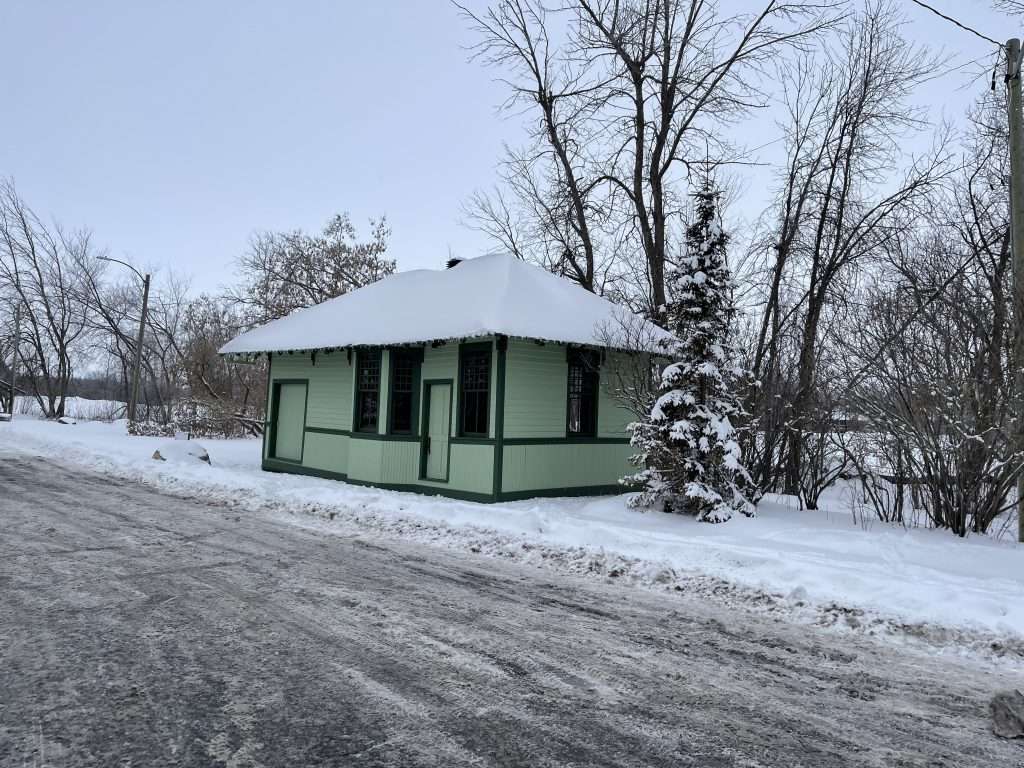
Embrun's Story
ESTABLISHMENT: 1845–1870
In the 19th century, thousands of immigrants from the old parishes of the Joliette and Beauharnois regions in Quebec arrived facing economic and social hardships caused by poor harvests and, above all, by overcrowded land. The seigneuries had been so subdivided from father to son that young couples received plots barely large enough to build a house and grow a kitchen garden. Meanwhile, lands outside those seigneuries had been granted to British settlers or to military officers who had defended Upper and Lower Canada against the Americans during the War of 1812. French-Canadian Catholics therefore had to look elsewhere. While the need to leave was clear, choosing where to go was far more difficult.
These immigrants were used to working low, damp soil, so instinctively sought out similar land when they moved. In addition, the Catholic clergy, omnipresent in Quebec society at the time, strongly opposed French-Canadian Catholics settling in English-speaking, Protestant regions where they might lose their language and faith. To the west of Quebec, in what is now the United Counties of Prescott and Russell, a whole region was opening up to trade and settlement. This territory had the huge advantage of remaining under British law, much beloved by the clergy. Moreover, vast tracts of low, wet land lay untouched, waiting for settlers. Bishop Bourget of Montreal saw in this the perfect chance to slow the flow of Quebecers to the United States while establishing a nucleus of French-Catholic culture in Ontario.
For this new territory to serve as a welcoming land, it needed an effective organization to look after the newcomers. To that end, on June 25, 1847, Bishop Bourget created the Diocese of Ottawa. Two years later, his first bishop, Eugène Guigues, founded a colonization society to encourage French Canadians from Lower Canada to settle the vacant lands of Upper Canada. The lands along the Castor River were quickly identified as rich and fertile.
The first French-speaking settlers reached Embrun in the mid-1840s, arriving via the Castor River, then the only access route into the backcountry. Settlement was slow at first, and the work was thankless and arduous. By 1852, seven years after the first land grant, the parish of Embrun still counted only 19 families. Yet over the following years dozens more newcomers joined the original nucleus, so that by the late 1860s Embrun housed about 200 families.
Isolated from everything, these pioneers barely managed to keep their families alive. Apart from potash and a few other products like firewood supplied to nearby markets, there was virtually no commercial exchange, since they produced little surplus and the road network was rudimentary.
Nevertheless, the residents built their first chapel in 1856, opened a school and post office in 1858, and welcomed their first resident priest in 1864. It was also during this period that the name “Embrun” appeared. Until then, parishioners called themselves “people of the Castor” after the river that ran through their lands. In 1857 the young missionary François-Xavier Michel, newly arrived from France, suggested naming the budding settlement after his home region in the Hautes-Alpes. A native of the Embrunais, he thought a historic name with a pleasant sound would suit the village well. He called it “Embrun,” in memory of the commune in southeastern France. Two years later Bishop Guigues chose Saint James as the parish patron to commemorate the many pioneers who came from Saint-Jacques-de-l’Achigan, Quebec.
DEVELOPMENT: 1870–1914
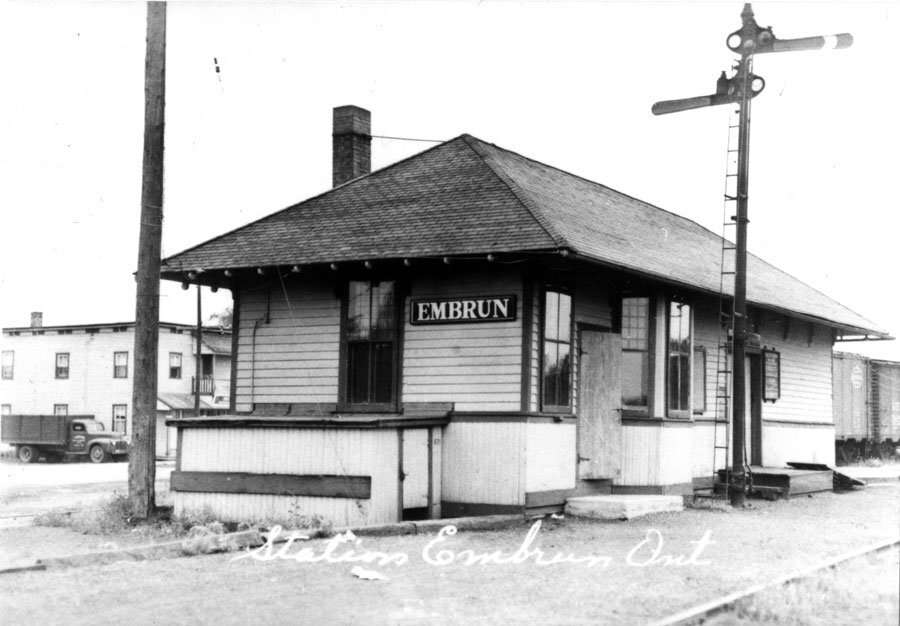
While better roads emerged with population growth and economic upswing, it was the arrival of the railway that truly transformed communications. Ottawa’s rapid growth in the 1870s spurred new transport links, including the railway to Montreal in 1881. But that line ran several kilometers north of Embrun and was often unreachable due to poor roads. Local residents long dreamed of a rail link serving their village. In 1897 the Ottawa & New York Railway’s decision to build a line connecting Ottawa to New York via Cornwall thrilled Russell Township and Embrun. Despite limited means, they voted a $10,000 subsidy to reroute the line through Embrun. Opened in 1898, the railway gave the village efficient transport, telegraph service, and regular mail delivery. Merchants used the train to import goods and export local products, with cheese even making its way to England.
Industrially, Embrun reached its peak at the turn of the century, with small operations now vanished—sawmills, gristmills, a carding mill, a shingle factory, a quarry, forges, livery services, cheese factories, tin shops, a brickyard, and more. Socially, the parish priest’s report of the era described a population of just over 2,000, predominantly French-speaking and Catholic—relatively poor and uneducated but deeply religious.
The arrival of Canon Jean-Urgel Forget in 1896 marked the start of his 50-year leadership. After putting parish finances in order, he focused on education, the economy, and spiritual welfare. He tirelessly represented his parishioners before government, securing the railway, a model school, a secondary school, a temperance society, and veterinary tuberculosis vaccines—testimony to his role as Embrun’s guiding force.
Between 1870 and 1914, Embrun also saw the arrival of the Grey Nuns of the Cross (1887), construction of the current church (1891), opening of the old Saint-Jean school (1907), and founding of various businesses, some surviving into the 21st century.
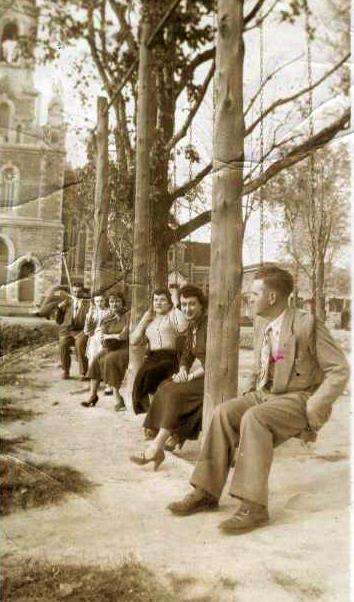
These swings were installed at the west end of École Saint-Jean, then located opposite the current presbytery. The people in the photo are obviously not students. They could be teachers who taught at this school, which closed as an educational institution in 1952. The building was demolished in 1963.
Embrun saw its real demographic and economic boom begin with the drainage of the lands in the early 1870s. Upon arrival two decades earlier, the first settlers had found fertile but seasonally flooded fields. The province’s drainage work starting in 1870 north of the Castor River extended the growing season and added 3,650 hectares of arable land.
The parish population rose from 213 families in 1871 to 500 by 1885. Entire families rather than just individuals then emigrated to the region, so that by around 1880, less than 30 years after the first arrivals, French speakers already made up 61% of Russell Township’s population. The village itself counted about 275 residents.
This influx of newcomers profoundly changed the local economy. New businesses and processing industries opened, transforming Embrun from a refuge for the elderly no longer able to farm into a place where one could earn a living off the farm. Colonization was virtually complete, and the village’s footprint roughly matched its size in the 1970s.
In the early 1880s, farmers grew buckwheat, corn, potatoes, and grains, while others entered the dairy industry. Thanks to their hard work, agricultural production rose to the point of exporting surpluses to Ottawa and nearby logging camps. But when those camps grew too distant to serve as markets, farmers needed a way to move perishable milk farther afield. At seven hours by road from Ottawa, milk would spoil before arrival. The solution was to turn milk into exportable cheese. By the early 20th century, Embrun boasted a dozen cheese factories across the village and surrounding concessions.
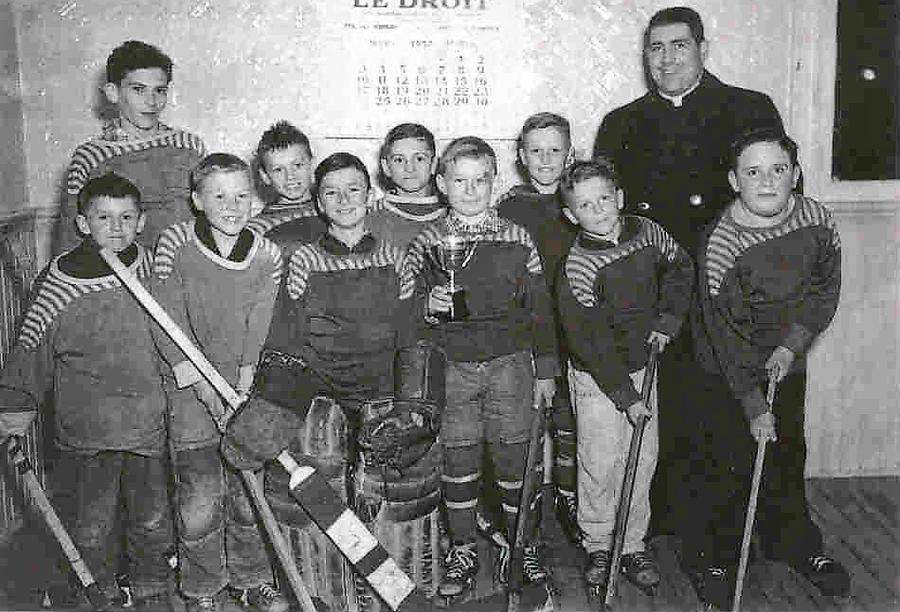
This team, which won the junior championship in 1957, was composed, from left to right in the front row, of Pierre Carrière, Marcel Roy, Gilles Ménard, Michel Nault holding the Caisse populaire trophy, Donald Émard and Guy Cardinal. Second row, same order, Edmond Dignard, Gaston Roy, Lucien Bourbonnais, Gilles Émard and Father Laurent Frappier, parish vicar.
RECESSION: 1914–1970
From World War I onwards, Spanish influenza, the Great Depression, agricultural crises, wars, and farm mechanization combined to create severe economic and social challenges throughout the region.
In Embrun this era saw agriculture decline as a source of employment due to poor markets and falling prices. Many farmers found themselves ruined, unable even to pay property taxes. The rural economy could no longer absorb its annual population growth, and entire families were forced to leave the parish much like their ancestors a century earlier. It’s estimated over 1,000 families abandoned their farms in Russell Township during the first half of the 20th century. In Embrun, the number of families fell from 452 in 1911 to 340 in 1921. Some emigrants settled in industrial centers like Cornwall and Detroit; others moved north to found new parishes in Noëlville, Verner, and Saint-Charles.
This mass exodus triggered the closure of many small businesses and industries, including the cheese factories. As roads improved, farmers began shipping milk directly to Ottawa’s large dairies, leading to the shutdown of local creameries that had made Embrun famous. The railway, which had served the village for nearly 60 years, also ceased operation in 1957.
Two major fires in 1919 and 1932 devastated Embrun’s downtown core. Only the church and school survived, with combined damages exceeding $130,000.
Even amid hardship, positive developments emerged. Likely in response to economic struggles, farmers banded together to form an agricultural cooperative in 1944 and a credit union the following year, both of which remain among the region’s most successful institutions.
Educationally, this period saw the opening of the normal school (1925), the high school (1935), and the new Saint-Jean school (1952).
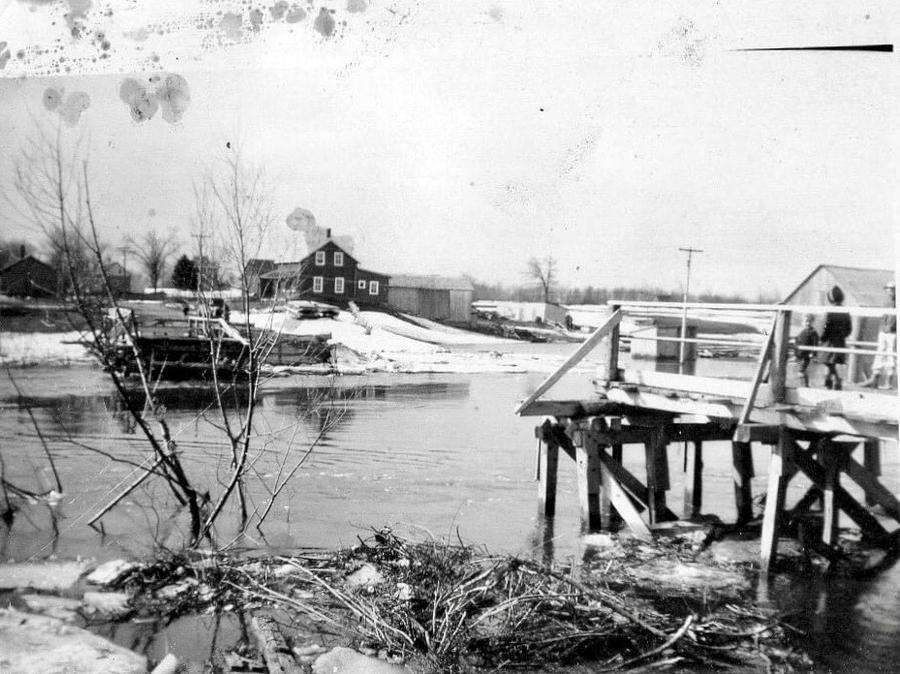
On April 6, 1947, shortly after 9 p.m., the iron bridge erected in front of the church in 1907 was swept away by the ice. The next day, it was found 900 feet downstream.
MODERN ERA: 1970 TO THE PRESENT
Over the past 50 years, Embrun has experienced remarkable demographic growth, driven by two main factors: the opening of Highway 417 in the early 1970s and the installation of municipal water and sewer services in the 1980s.
Highway 417, linking Ottawa to the Quebec border, passes a few kilometers north of Embrun. While this major route made it easier for locals to reach the capital, the reverse also occurred with thousands of city dwellers attracted by the village’s economic and social advantages moving to Embrun while continuing to work in Ottawa. The population, around 2,200 in 1960, rose to 2,800 in 1980, 4,500 in 2000, and 8,700 in 2021—double Ontario’s overall growth rate for the same period.
Installing water and sewer networks north of the Castor River in the 1980s proved even more decisive. Farms surrounding the village were subdivided into hundreds of residential lots, accommodating new families.
The village’s footprint has nearly multiplied tenfold in 50 years. In the late 1960s, Embrun hugged Notre-Dame Street from St-Onge in the west to the cemeteries in the east; now urban sprawl extends well onto former farmland north of the village. So far, development south of the Castor River has been spared, likely because services haven’t yet reached that sector.
This growth has profoundly changed Embrun’s social character. A century ago, the village’s population was only 16% of the rural parish; today it exceeds the rural population. Local authorities must now provide urban-style infrastructure—roads, cultural and recreational facilities, schools, utilities—to these new residents.
Economically, the boom spawned many new businesses. Yet Highway 417, by providing easy access to larger centers, also draws away local labor and resources, preventing major industries from taking root in Embrun. The village has become largely a bedroom community, its economy centered on retail and services.
Socially, the influx of English-speaking residents over the past 50 years now seriously threatens Embrun’s Francophone character. While the village was 98% French-speaking around 1960, that proportion fell below 50% by 2025. In daily life, English is increasingly common; if Francophones are to preserve their language here, young people in particular will need to show much more determination.